.png)
I updated Alex Chavez, now I am creating her art myself

Alex Chavez has been part of Artist’s Launch Academy from the beginning.
She is the fictional artist students follow as they learn how to research collectors, define their positioning, plan a website, develop offers, create campaigns, and build a complete art marketing system.
Alex gives me a way to turn marketing concepts into practical examples.
Instead of only explaining what art marketing is, I can show students how Alex conducts her own art marketing systems. Instead of describing a launch campaign in the abstract, I can demonstrate how Alex might introduce a new collection. Instead of telling artists to organize their websites strategically, I can build Alex’s website alongside them and explain why each decision is being made.
Alex is fictional that I created. The marketing decisions surrounding her are designed to feel real because they are based real artist stories and experiences. As Artist’s Launch Academy has developed, however, Alex has developed too. Her medium has changed. Her location has changed. The way I represent her visually has changed. Most importantly, I am no longer using artificial intelligence to create her artwork.
I am creating it myself.
Who Alex Was Originally
When I first developed Alex, she was a neon oil painter whose work explored how bees may see the natural world through ultraviolet vision.
Her artwork combined vivid interpretations of New Mexico landscapes with bright pinks, purples, blues, and greens. The concept gave her a distinct artistic position and helped me demonstrate how an artist could transform a specific interest into recognizable branding, educational content, and an interconnected collection.
She was also preparing to leave New Mexico and build a new chapter of her career in New York.
That version of Alex gave me an interesting foundation for the Academy. She had a clear artistic concept, a strong connection to place, and a major professional goal that created natural marketing challenges for students to examine.
But while the marketing strategy made sense, the practical side of creating her world did not.
Why Alex Is No Longer an Oil Painter
Building Artist’s Launch Academy requires me to create more than lessons. I am writing curriculum, developing workbooks, building examples, creating graphics, testing systems, planning campaigns, designing websites, and documenting the decisions behind the program.
I would also need to learn oil painting well enough to create a believable body of work for Alex.
That is not a small additional project.
As you know, oil painting is a medium that requires its own materials, techniques, processes, drying times, and learning curve. I could eventually learn it, but attempting to do so while building the Academy would take attention away from the work I am already responsible for completing.
Alex’s artistic concept needed to become something I could genuinely create.
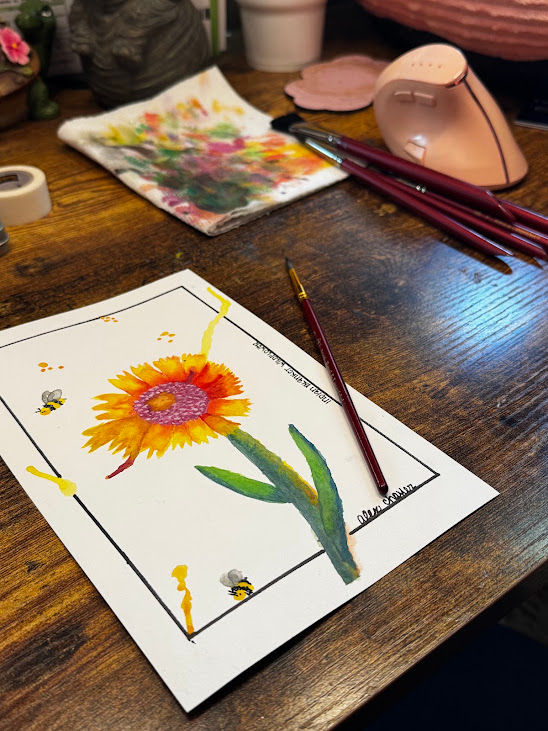
For now, Alex is a watercolor artist.
Her work can still explore New Mexico landscapes, native plants, pollinators, ultraviolet vision, environmental relationships, and the hidden details of nature. The larger ideas behind her art do not have to disappear simply because her medium changed.
They can be interpreted differently.
Instead of thick layers of neon oil paint, her work may use transparent washes, loose botanical details, bright color studies, ink outlines, and imaginative interpretations of how insects experience the landscape.
The medium changed, but the opportunity to build a recognizable body of work remains.
That is also an important lesson for artists.
Your medium, collection, offer, or long-term vision can change without erasing the foundation you have already built.
Returning to Watercolor
Watercolor is not completely new to me.
When I was growing up, my older sister tried to help me find my artistic medium. Her belief was that everyone was capable of creating art. They simply needed time, experimentation, and the right medium to create what they imagined.
We tried everything. We experimented with drawing, painting, different materials, and even my Play-Doh. Watercolor was one of the mediums I explored during that period. I did not continue building a formal watercolor practice, but the experience remained somewhere in the background.
Now, years later, I have returned to it because my business required me to create. That has been one of the more unexpected parts of building Artist’s Launch Academy. I began this project as a marketer and educator working with artists. I did not expect the process to require me to step back into art myself. But as the Academy became more visual and more scenario-based, I needed artwork, examples, teaching graphics, collection concepts, and creative materials that belonged specifically to Alex’s world.
Creating those materials myself became the most practical and honest direction.
I have especially enjoyed using watercolor to create educational graphics.
Watercolor allows the teaching materials to feel connected to the artists using them. The graphics do not need to feel like polished corporate diagrams. They can look drawn, explored, annotated, and worked through by hand.
That visual language fits the Academy.
Artist’s Launch Academy is teaching serious business structure, but it is still being built for creative people. The materials should feel strategic without becoming disconnected from the act of making art.
Why I Stopped Using AI to Create Alex’s Art
In the original version of Alex, I used AI-generated images to help establish her appearance and create examples of her artwork.
I was transparent about that decision, but I was never completely comfortable with it. I was trying to solve a practical problem. Alex was a fictional person with a fictional portfolio, and I needed students to visualize her as a complete artist rather than a collection of written exercises.
AI allowed me to produce that visual world before I had the resources to create it another way.
But Artist’s Launch Academy exists to serve artists. As the program developed, it became increasingly important for the way I created Alex’s work to reflect the values behind the Academy.
I do not want to teach artists how to build value around their work while using AI to manufacture the artwork at the center of my own teaching example.
I also discovered that creating Alex’s art myself gives me something AI never could: direct experience with the decisions I am asking artists to make.
I now have to think about:
What Alex’s visual style actually looks like
Which subjects belong together in a collection
How long each piece takes to create
Which materials are practical
How the artwork should be photographed
What can be reproduced as a print
How the creative process becomes content
How a collection develops over time
What happens when the original idea exceeds the artist’s current resources
Those are not hypothetical questions anymore.
They are part of the work.
That makes Alex a stronger teaching tool because I am no longer only designing her marketing from the outside. I am experiencing part of her creative process from the inside.
How Alex Will Be Represented Now
I will use stock photography to represent Alex as a person.
Stock images will allow me to create website pages, campaign examples, social posts, artist biographies, studio scenarios, and other educational materials without pretending that the person shown is the actual creator of the artwork.
Alex remains a fictional artist.
The photographs are visual representations used to help students follow her story. Her artwork, however, will be created by me through watercolor, ink, and other traditional materials I decide to explore.
This solution is not perfect, but it is clear.
I would rather be transparent about using stock photography than create an artificial person and ask students to emotionally invest in a representation that looks increasingly real.
One day, I hope to find my Alex.
I would like to work with a real model who connects with the character and arrange an official photography session. We could photograph her hiking, painting, preparing for markets, working at a table, packaging orders, and interacting with the landscapes that shape Alex’s story.
Those photographs could then be used to update Alex’s website and strengthen the educational examples throughout the Academy.
That is a future investment.
For now, stock photography allows the project to continue responsibly within the resources I have.
Alex Is Staying in New Mexico
Alex’s location has also changed.
Originally, Alex was preparing to move from New Mexico to New York. That transition created useful teaching scenarios because she needed to enter a new market, build recognition in an unfamiliar city, and connect her New Mexico roots with a new audience.
But Alex is no longer moving right now.
She is staying in New Mexico with her family.
That does not mean New York has disappeared from her future permanently. She may decide to pursue that goal later. She may visit, exhibit there, develop collector relationships there, or eventually move when the timing makes sense.
But that is not the chapter she is in today. Like me, Alex sometimes has goals that change.
That makes her more realistic. Business plans are important, but they are not contracts with a former version of yourself. New information, responsibilities, financial realities, family needs, creative interests, and unexpected opportunities can change the direction of a business.
A changed goal is not automatically a failed goal.
Sometimes it is a better-informed decision. Alex can still build an ambitious art business while staying near her family. She can strengthen her local reputation, sell online, develop relationships with collectors outside New Mexico, participate in regional events, and prepare for larger opportunities without relocating immediately.
Her marketing system should support the life she is building now,not pressure her to perform a plan that no longer fits.
What This Update Teaches Artists
Alex’s evolution reflects one of the central principles of Artist’s Launch Academy: Your marketing system must be built around the business you can genuinely operate.
A strategy may sound impressive and still be unrealistic. An artistic concept may be interesting and still require resources you do not currently have. A major move may be exciting and still be wrong for this particular season. A branding decision may work temporarily and still need to be reconsidered as your values become clearer.
Artists are allowed to make informed adjustments. The important question is not whether your original plan changed.
The important questions are:
Why did it change?
What did you learn?
Which parts are still useful?
What can you realistically support now?
How should your marketing change with your direction?
What are you building toward next?
Building Alex in Public
Alex was created to make art marketing easier to understand. She is not meant to represent a flawless artist with unlimited time, money, confidence, materials, or opportunities. She is meant to help students see how real decisions move through a complete marketing system. That means her story should be allowed to change.
She can reconsider her medium.
She can delay a move.
She can work with the resources available to her.
She can build locally while developing a larger vision.
She can revise her website when her direction becomes clearer.
She can create one collection before she knows exactly what the fifth collection will become.
That is not inconsistency.
That is development.
I am building Artist’s Launch Academy in much the same way. The foundation is deliberate, but the process continues to teach me what the program needs. Returning to watercolor was not part of my original plan. Creating Alex’s artwork myself was not part of my original plan.
But both decisions have brought the Academy closer to the kind of educational experience I want to provide: practical, transparent, creative, structured, and grounded in what it truly takes to build an art business.
Alex is still fictional.
Her marketing system is still educational.
But the art is becoming real.


Comments